A seizure detector that listens to brain, heart and muscle at once.
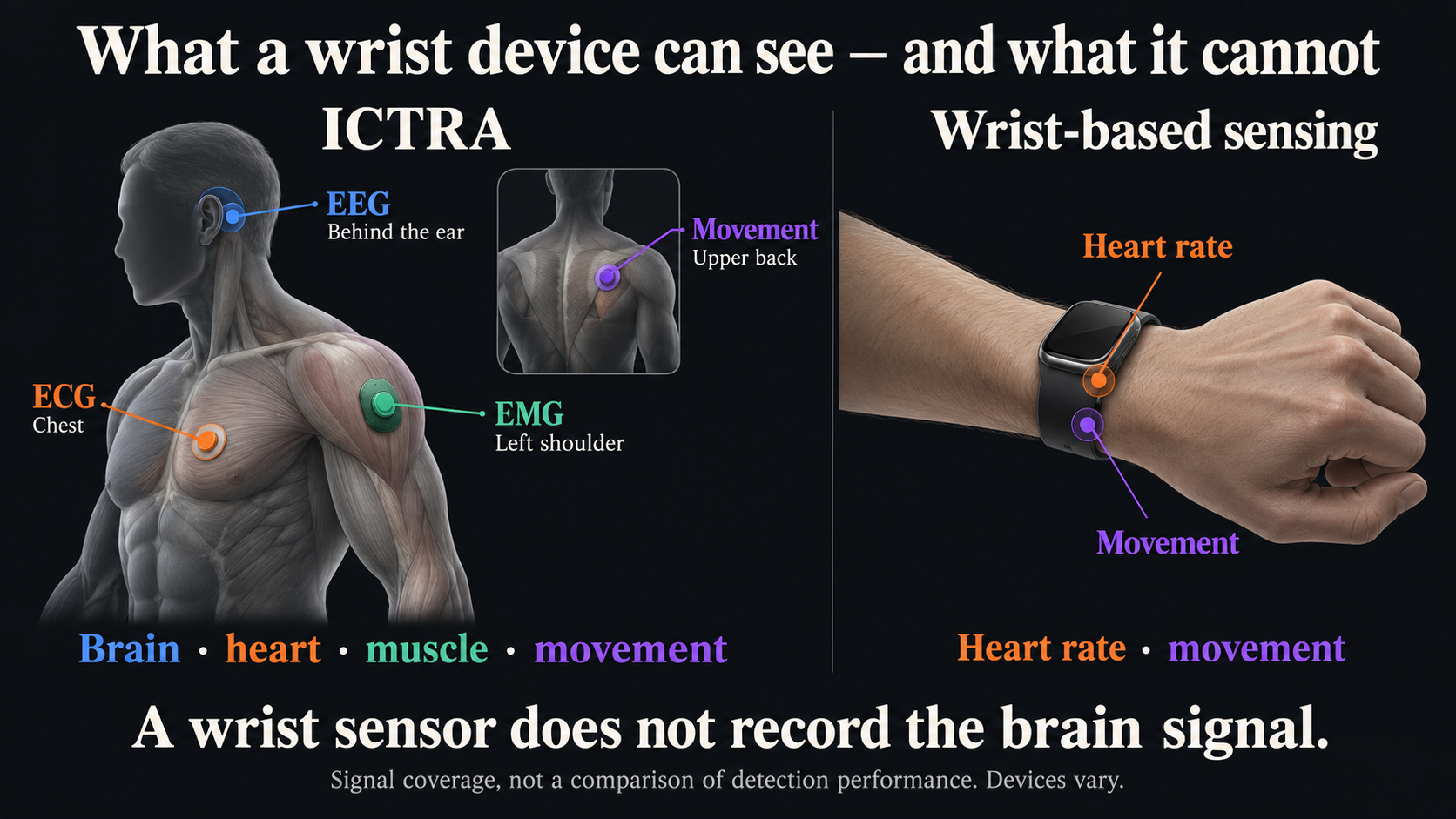
Two electrodes behind the ear, one on the chest, one on the shoulder, and a model developed on the public SeizeIT2 dataset: 11,626 hours from 125 patients. Built by four students to count the seizures nobody sees.
29 patients no model had ever seen. Three of the four pre-registered hypotheses held; one did not, and one of our own earlier findings failed to replicate. The locked-test results →
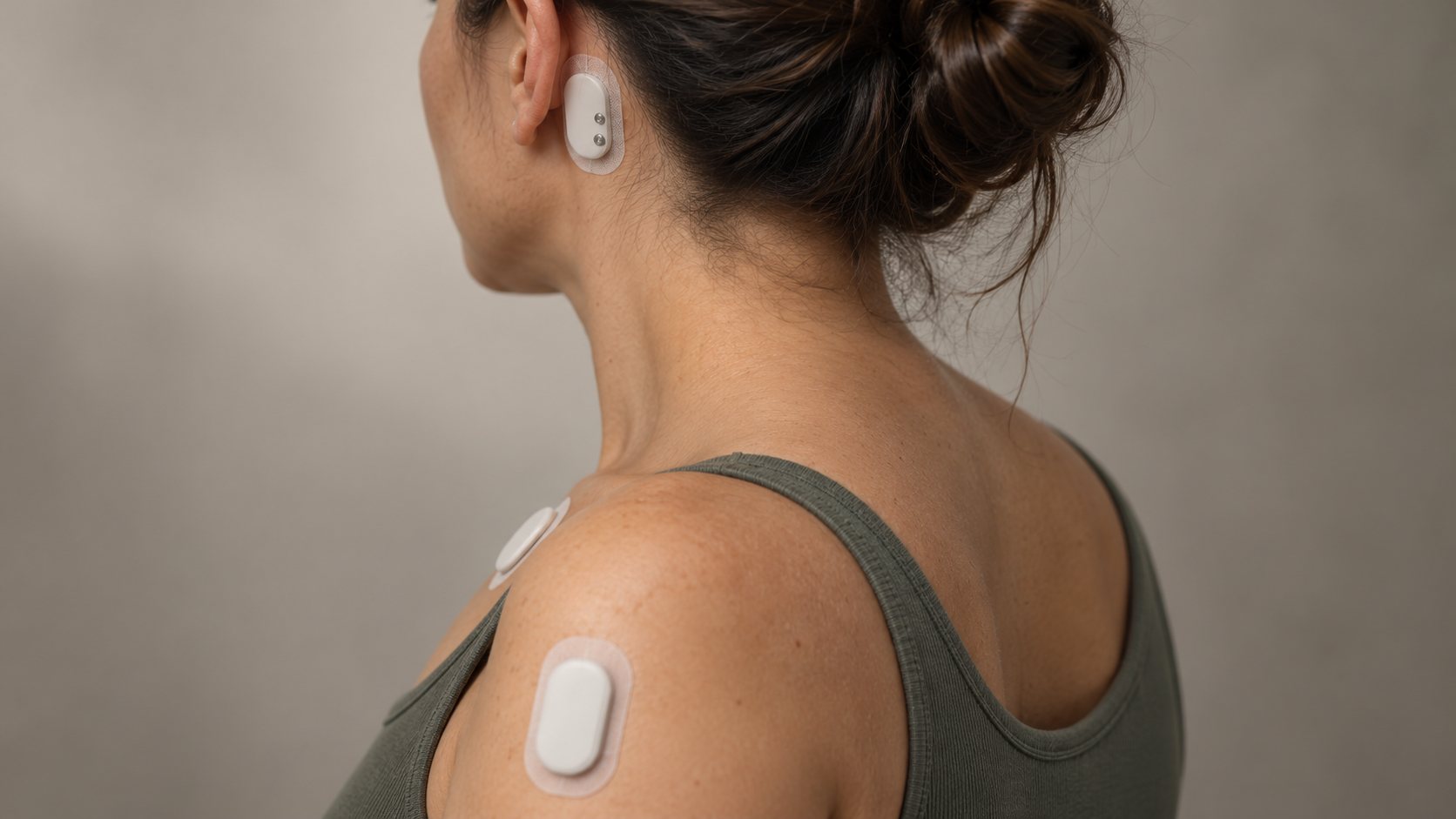
Watch concept animation (AI-generated)
Concept render (AI-generated), not a verified hardware assembly or a functioning device.
Three signals. Shared time.
Synthetic signal demonstration
Explore the research
The question, the method, the engineering and the evidence behind ICTRA.
The seizures nobody counts
50 million people; BC has 0.83 monitoring beds per 1,000 refractory patients; diaries miss half of all seizures; SUDEP follows unwitnessed convulsions.
Why this project → Artificial intelligenceMeasure the timing, then fuse
Signal timing measured across 695 seizures before any model was built; three models that differ by one signal each; a decision rule anyone can read.
AI & method → Technical skills126 GB, verified, every hour processed
Open Arduino acquisition, SHA-256 downloads, one signal-processing code path, GPU training, a live lab dashboard.
Engineering → EvidenceNumbers from patients we never trained on
Three tiers of test, patient-bootstrap intervals, the dataset authors' own algorithm as the reference, and every dead end kept.
Results → AI ethicsSilence must never mean safety
Missed seizures, false alarms, brain data that stays home, who the model was not trained on, and why this is not a medical device.
Ethics → PresentationFour branches, four owners
Who presents what, the 30-second version of each result, and the questions each member is ready to take.
Team →What is new here
Three contributions, with links to the supporting work.
We measured when the heart, muscle and movement react relative to the brain in every seizure type before designing the fusion — and rewrote a hypothesis when the data disagreed.
Exhibit 1 →The published ear-EEG detector uses EEG + ECG and needs a human reviewer; consumer watches see only convulsions. ICTRA models all four signals and reports every focal seizure type, including the ones it misses.
Where we stand →Patient-wise folds, a locked test set, hypotheses fixed in advance, a stated accept rule and a public record of dead ends. The pre-registration was hashed and published before the locked patients were scored — and we report the hypothesis that failed and the finding that did not replicate.
Dead ends →From a noisy home-built board toward a frozen model and a blind test: the timeline, the version that was rejected, and the plan. Read the journey →
Status · 28 October 2026
Data and training
- Seizure recordings
- 1,163 files · 24.8 GB · complete, SHA-256 verified
- Seizure-free hours
- all 6,894 files downloaded and featured (stage 2 complete)
- Versions
- v02g (offline) and v11 (causal) frozen and hashed on 26 Oct · v03 and v03b rejected under the pre-set rule · nothing changed after the freeze — how it evolved
- Locked test
- opened 28 Oct 2026, run once. sub-097…125 are development data from now on — results
Next
- This week
- The locked test is spent. Writing up what it showed, including the hypothesis that did not hold and the one that failed to replicate
- November
- External evaluation: a request to the SeizeIT2 authors to run the frozen model on data we have never had access to, and a submission of the EEG-only model to the EPFL SzCORE benchmark. SzCORE accepts only 19-channel scalp EEG, so that one measures how far a behind-the-ear model transfers to scalp recordings — not the four-signal system. Both are submitted once. They are the only untouched tests we have left
- Hardware
- Wearable prototype and a real-time demo video by 10 Nov
- Submission
- 29 November 2026
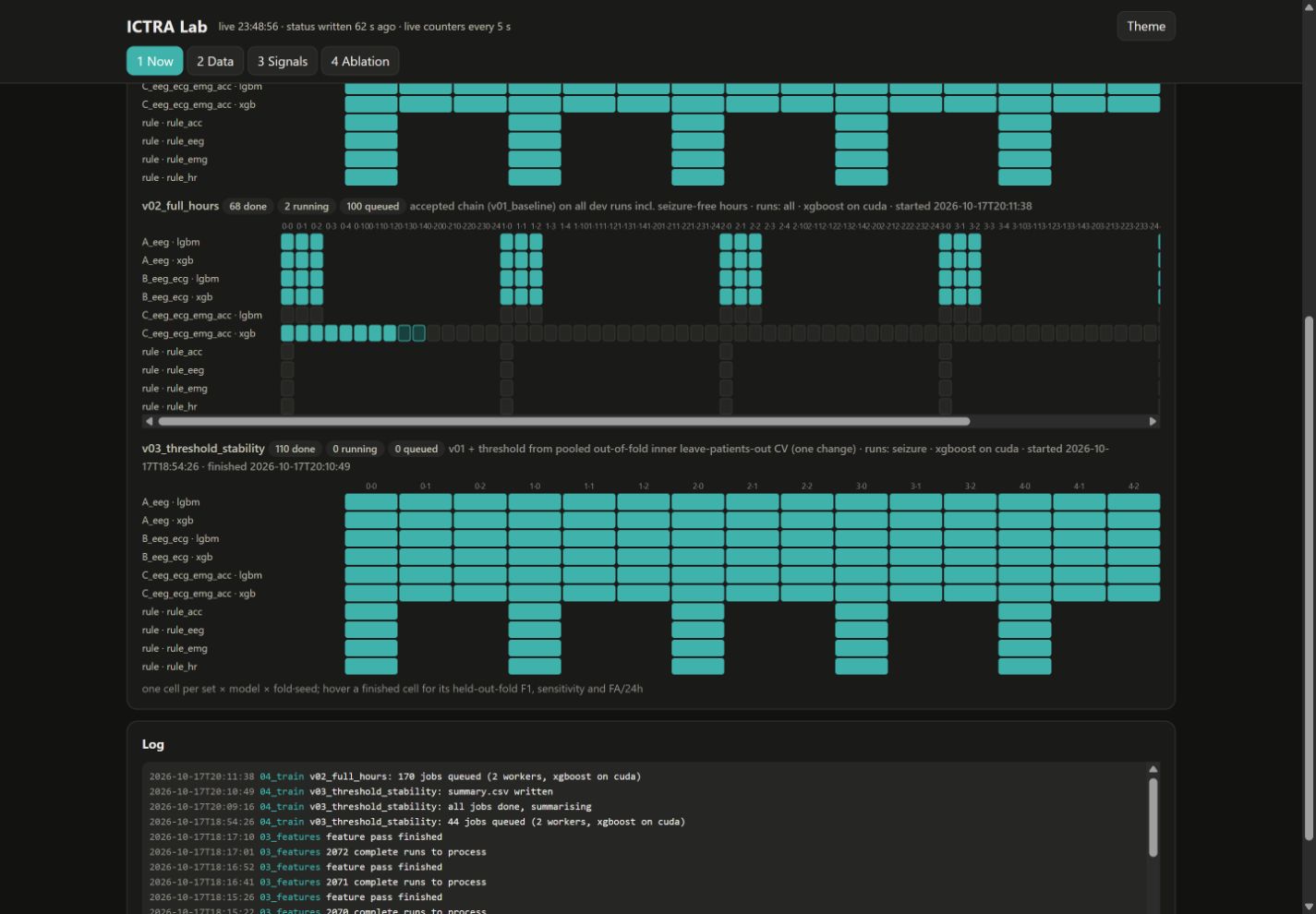
Recorded pipeline: ICTRA Lab screenshots and explanations →